The Interplanetary Chronicle

Because reality isn’t ridiculous enough.

Back home

Everything below is entirely fictional. Any resemblance to real people, events or planets is purely unfortunate.

In this edition

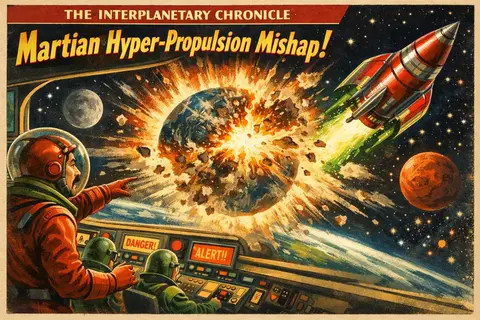
'I Am Still Alive!' Announces Tech Visionary From Scorched Martian Outpost After Earth Unlocking Protocol

CRITICS LABEL THE COMPLETE DESTRUCTION OF HUMANITY'S HOME PLANET AN "OVERSIGHT," WHILE SHAREHOLDERS PRAISE UNMATCHED OPERATIONAL AGILITY AND A 90% WORKFORCE REDUCTION EFFICIENCY.

By Amthonie Vandenberg, Senior Interplanetary Correspondent

OLYMPUS MONS, MARS — In what is already being called the most disruptive product launch in sentient history, billionaire visionary and Chief Martian Pioneer Leon Sumk confirmed today that his experimental hyper-propulsion engine successfully ignited, generating enough immediate localised kinetic energy to achieve escape velocity from Earth. The process, which technical teams described as a "a rather energetic thermodynamic mishap," unfortunately resulted in the total visual and physical evaporation of the third planet from the Sun.

Speaking via an ultra-low-latency quantum uplink from the newly constructed X-Base Alpha, Sumk reassured remaining organic intelligence networks that the mission was an overall success:

"I am sorry I had to blow up the Earth to gain enough energy for my trip to Mars. But the good news is that I have landed safely on the planet. Unfortunately the Martians give us a hard time and 90% of the colonists are already dead. But hey, I am still alive!"

The announcement has sparked fierce debate among the solar system’s surviving entities—mostly consisting of automated trading algorithms, weather satellites operating without targets, and the skeletal remains of the International Space Station. Analysts argue that while the eradication of the biosphere removes significant consumer data pipelines, the structural overhead savings are unprecedented.

"If you look at the macro trends, Earth was bogged down by heavy legacy regulatory frameworks like the Geneva Convention and gravity," noted one automated financial analyst script. "By migrating the primary human demographic to a pure, unblemished vacuum, Sumk has effectively eliminated the liability of a native ecosystem. This is peak operational velocity."

However, the landing was not entirely without friction. Upon touchdown in the Jezero Crater, the colonization fleet immediately encountered localised hostilities from an indigenous silicon-based subterranean civilization. The native population, unaccustomed to hyper-capitalist eminent domain, launched a series of sophisticated subterranean plasma offensives.

According to internal memos leaked by the remaining 10% of the mission's staff, the survival rate among corporate colonists has plummeted dramatically within the first 48 hours. The atmosphere of Mars, combined with high-velocity native artillery, has proved "rather challenging for the junior product teams."

Sumk, however, remained characteristically undeterred by the attrition rate, noting that human capital is inherently renewable and that surviving an extinction event is, statistically speaking, the ultimate competitive advantage.

MARKET UPDATE: STELA STOCK EXPLODES SPATIALLY

Despite the complete liquidation of Stela’s manufacturing plants, gigafactories, and entire global customer base in the explosion, STLA shares surged 4,200% in pre-vacuum trading. Speculators believe that with zero competition left alive on Earth, Stela now commands a true 100% global market share.

"The engineering team is looking into patch updates for the Martian offensive grid," Sumk tweeted later into the empty cosmos. "90% of colonists may be permanently offline, but the core architecture is robust. Optimizing for respawn cycles next quarter. Mars is hard, but surviving it alone is cautiously optimistic in the most unreasonable way."

At press time, sources confirmed the lone billionaire was seen scouting real estate near the Martian equator, safely unbothered by zoning laws, property taxes, or human survivors.

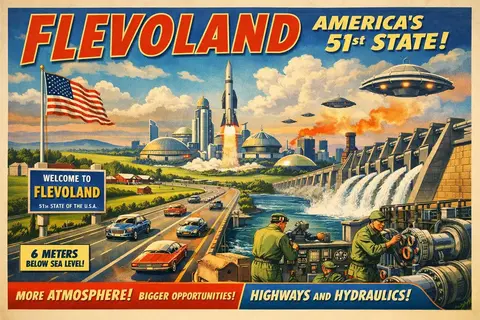
Flevoland Ceded to US in Global 'Greenland Compromise' as President Celebrates 'Beautiful New Island'

DUTCH PRIME MINISTER LABOURS TO CONCEAL ABSOLUTE JUBILATION OVER RETAINING THE WADDENEILANDEN IN LAND-SWAP ACCORD.

By Amthonie Vandenberg, European Geopolitical Correspondent

THE HAGUE — In an extraordinary diplomatic maneuver aimed at pacifying American territorial ambitions, the Dutch government has formally signed over the entire province of Flevoland to the United States of America.

The transaction is the first of many under the newly ratified "Greenland Compromise." The treaty was drafted after the US President, Danuld Promt, renewed his aggressive bidirectional bid to purchase Greenland. Following a unified blockade from European leaders refusing to sell the world's largest island, a frantic compromise was brokered: every European nation must instead surrender one of their own domestic islands to satisfy the American real estate appetite.

According to leaked diplomatic cables, the Netherlands originally offered the pristine, ecologically protected Waddeneilanden (Frisian Islands) to the Americans. However, President Promt reportedly rejected the offer during a heated telephone exchange, dismissing the UNESCO World Heritage site as "low-energy sandbanks with too many birds" and demanding "something firmer, ideally with a Lelystad Airport."

Enter Flevoland—the world’s largest artificial island, drained entirely from the Zuiderzee by Dutch engineers in the 20th century.

"It is a regrettable, though hardly unexpected day for the Kingdom," the Dutch Prime Minister announced to a somber press room, while visibly biting the inside of his cheek to stop himself from smiling. "we mourn the regrettable departure of Almere, but geopolitics requires sacrifice."

Sources close to the Prime Minister report that as soon as the American delegation left the room, senior cabinet members quietly opened a modest bottle of champagne, thrilled to have successfully tricked the US administration into taking a giant, flat expanse of reclaimed polder while keeping the beloved Waddeneilanden firmly in Dutch hands.

President Promt, speaking from a newly constructed golf course blueprint superimposed over Urk, praised his own negotiating prowess.

"The Dutch tried to give us some weak islands. Very wet. No infrastructure. I said no, give us the big one," Promt told reporters. "Flevoland. Great name. A lot of people are saying it’s the best land. It’s six meters below sea level, which means we get more atmosphere than anyone else. Tremendous leverage."

Under the terms of the cession, Flevoland will immediately be integrated as the 51st US State, with local traffic laws expected to be replaced by six-lane highways by Tuesday. The Dutch government has politely declined to mention that the dikes require continuous, highly complex maintenance, leaving the US Army Corps of Engineers to figure out the pumps on their own.